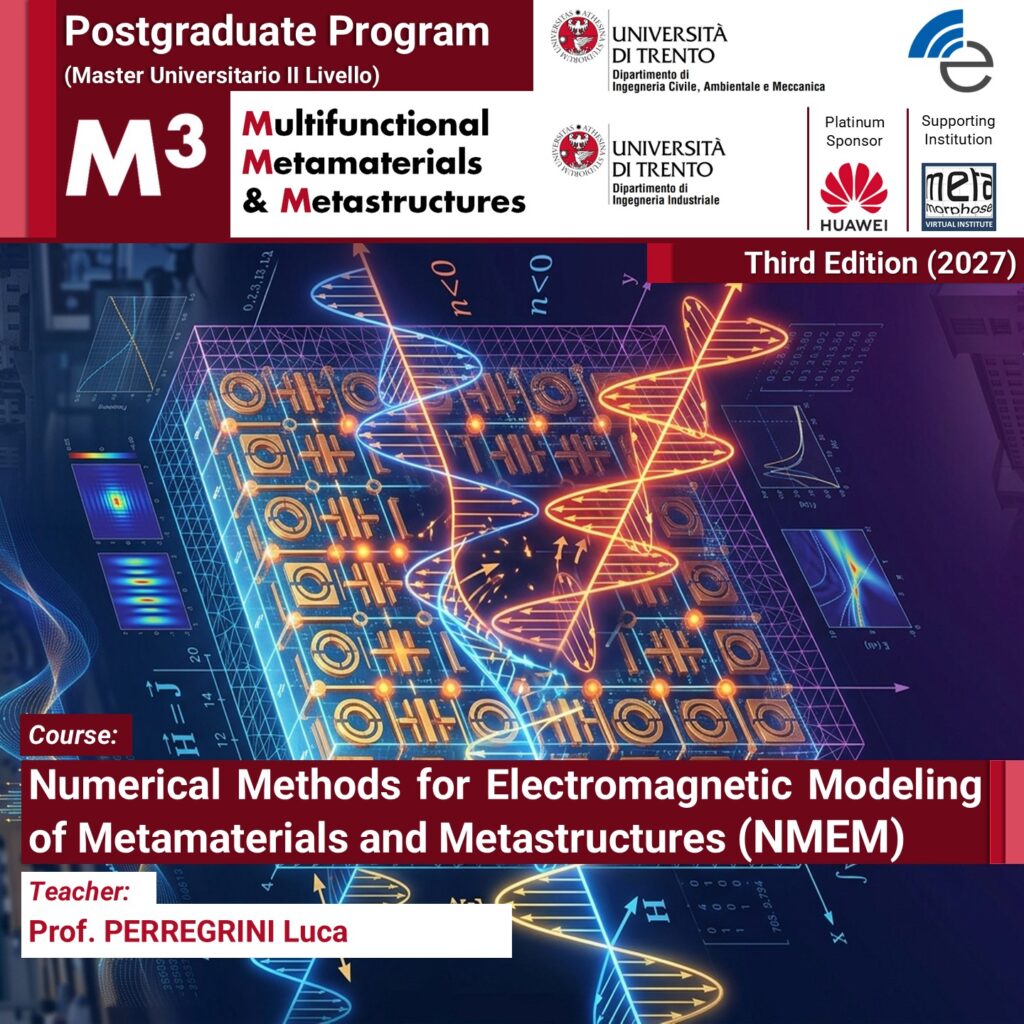
The ELEDIA Research Center is pleased to present a course from the 2027 Edition of the Postgraduate Program (Master Universitario di II Livello) on Multifunctional Metamaterials and Metastructures (M3) at the University of Trento!
𝗖𝗼𝘂𝗿𝘀𝗲: Numerical Methods for Electromagnetic Modeling of Metamaterials and Metastructures (NMEM)
𝗧𝗲𝗮𝗰𝗵𝗲𝗿: Prof. PERREGRINI Luca
𝗘𝗖𝗧𝗦: 3
𝗗𝘂𝗿𝗮𝘁𝗶𝗼𝗻: 15 Hours
𝗪𝗲𝗯𝗽𝗮𝗴𝗲: https://master-m3.unitn.it/2027-numerical-methods-for-electromagnetic-modeling-of-metamaterials-and-metastructures/
Abstract:
This course provides an introduction to numerical methods for the electromagnetic modeling of metamaterials and metastructures, combining theoretical foundations with practical implementation.
Participants will explore key computational techniques for analyzing and designing engineered materials with tailored electromagnetic properties. The course covers the modeling of periodic and subwavelength structures, boundary conditions, and numerical stability considerations.
Through selected case studies, participants will gain insight into applications such as electromagnetic-wave manipulation, cloaking, and advanced antenna design.
By the end of the course, they will have acquired the fundamental tools needed to simulate and interpret the electromagnetic response of complex metamaterial systems.
Course Format
The course is taught in 🇬🇧 ENGLISH and offered:
– On-site
– Online, in synchronous and asynchronous modes
Video recordings, hand-outs, and additional learning materials are available offline.
What You’ll Learn
- The fundamental principles of computational electromagnetics
- How numerical methods can be used to model metamaterials and metastructures
- The theoretical foundations and practical implementation of the Finite-Difference Time-Domain method
- The fundamental principles and applications of the Finite Element Method
- How to model periodic and subwavelength electromagnetic structures
- How boundary conditions and numerical stability affect electromagnetic simulations
- How metasurfaces can be numerically analyzed for electromagnetic-wave manipulation
- How to simulate and interpret the electromagnetic response of complex engineered materials
- How computational methods support applications such as cloaking and advanced antenna design
- How to apply theoretical concepts through software-based exercises and selected case studies
M3 Opportunities
𝗗𝗶𝗱 𝘆𝗼𝘂 𝗰𝗼𝗺𝗽𝗹𝗲𝘁𝗲 𝗮 𝟰-𝘆𝗲𝗮𝗿 𝗕𝗮𝗰𝗵𝗲𝗹𝗼𝗿’𝘀 𝗱𝗲𝗴𝗿𝗲𝗲 𝗮𝗯𝗿𝗼𝗮𝗱?
Graduates holding a 4-year Bachelor’s degree obtained abroad are eligible to apply. If admitted, they will follow dedicated learning activities to align with the program requirements.
𝗪𝗵𝗮𝘁 𝗮𝗿𝗲 𝘁𝗵𝗲 𝗸𝗲𝘆 𝗳𝗲𝗮𝘁𝘂𝗿𝗲𝘀 𝗼𝗳 𝘁𝗵𝗲 𝗽𝗿𝗼𝗴𝗿𝗮𝗺?
Key features are:
- Courses taught in English 🇬🇧
- On-site and online participation (synchronous and asynchronous) 🖥️
- Access to video recordings, lecture notes, and additional learning materials 📚
Learn more: https://master-m3.unitn.it/
Discover the 2027 grants: https://master-m3.unitn.it/2027-grants/
Apply now: https://master-m3.unitn.it/2027-admission/
Read the news on: